 Support copilot preview
Prepared for the Spectrum team
Support copilot preview
Prepared for the Spectrum team
Support copilot preview
Prepared for the Spectrum team
Support copilot preview
Prepared for the Spectrum team
A working demo, not a slide deck

The 5am check, the weekend frost event, the station that went quiet on a Sunday. That is when the questions arrive.
Every article your team has written, answering a grower at 5am before the irrigation window, or on a Saturday when the frost alert did not arrive.
Two ways in, both live on this page: the chat window and a voice rep. When a case needs a person, your team gets it with the details already collected.
Live and answering right now, built on your 39 published articles
Channel one, the one your customers already use
This is live. Ask it anything about WatchDog stations, FieldScout meters or SpecConnect, and push on it. It answers only from your own articles, so where your documentation stops, it says so and hands the case over rather than inventing something.
It remembers you between visits, like it would for a real customer. Use this so the next person on your team starts clean.
Channel two, for the ones who would rather talk
A support rep that picks up at 5am, walks one step at a time, spells out the phone number instead of reading links, and collects the details before it hands a real case to your team. Same knowledge as the chat, same refusal to guess.
Tap the microphone to start. It asks permission first and nothing records until you do. Speak normally, and interrupt it if it runs long. You can also open it in its own tab.
What it works from
Every one of the 39 articles your team has published is in here, across all seven categories, with the source link attached to the answer. A sample of what it can already walk somebody through:
When it cannot answer
Order status, an RMA, warranty, pricing, anything the documentation does not cover, or a customer who simply wants a person. It stops guessing, collects what your team would have had to ask for anyway, and passes it over. Try it on either channel above: ask for a person about a repair and watch it take your name, product and serial before it hands over.
One question at a time, the way your documentation is written.
Illustrative example. Nobody on your team starts a hard case from zero, and nobody asks the customer to repeat themselves.
On your site
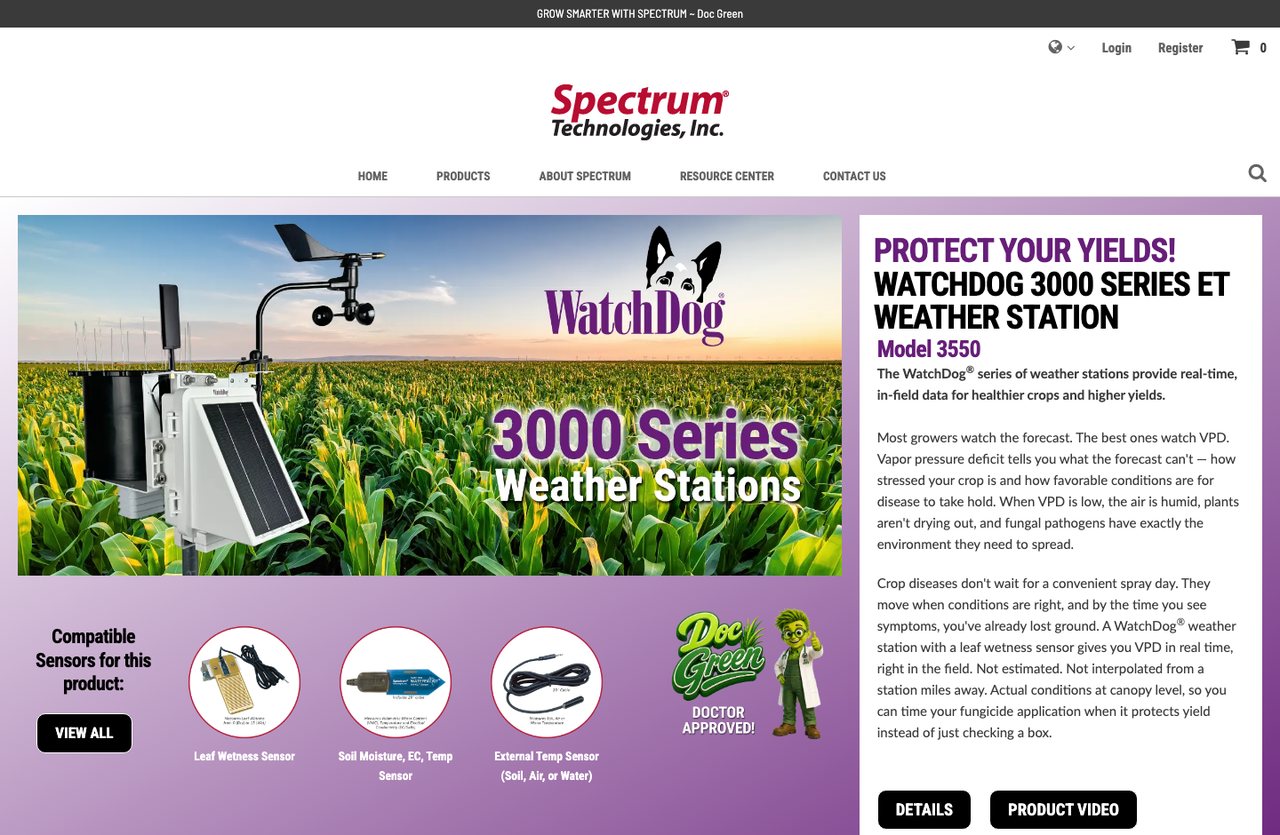
Your marketing team already put a chat window on specmeters.com. This replaces what sits behind it. Same corner, same habit for your customers, an answer instead of a routing form.
 SpecConnect Support
Answers in seconds
SpecConnect Support
Answers in secondsYour homepage exactly as it is today, with the copilot shown in place. Nothing about the site itself changes.
Why this matters
Tech support runs Monday to Friday, 8:00 to 4:30 central, by phone. Growers and turf managers work dawns, evenings and weekends. That is not a staffing failure, it is arithmetic.
168
125.5
39
Phone support runs Monday to Friday, 8:00 to 4:30 central. A week has 168 hours.
| Channel | Hours covered per week | Share of the week |
|---|---|---|
| Phone support today | 42.5 | 25% |
| With the copilot | 168 | 100% |
The other 125.5 hours are when frost events, dawn irrigation checks and weekend problems actually happen.
When someone with years of troubleshooting in their head leaves, the answers leave with them. Everything the copilot knows lives in your knowledge base, in writing. Every article your team improves makes it permanently better, and the next hire arrives to a system that already knows the answers.
"How do I add a user" and "why is my report timing out" stop reaching a person. What does reach them arrives triaged: name, product, serial, the issue, and what has already been tried. Fewer interruptions, and a faster start on the cases that genuinely need a human.
The next iteration
Today it knows your documentation. It does not know whether station 3550 reported this morning. Your own SpecConnect API already exposes that, and your documentation describes how to reach it. Give the copilot read access scoped to the customer asking, and the deflection stops being documentation and starts being support.
Today
"Is my station reporting?"
I cannot see your account from here. In SpecConnect, check the equipment page for the last upload time. Want me to have support look at it with you?
With account access
"Is my station reporting?"
Station 3550 last uploaded 6 minutes ago and the battery is at 92 percent. Your subscription renews in 47 days. Anything else look off to you?
Already in production
Same technology, different industries. The closest to you is a pharmacy phone line: same shape of problem, same volume, answered around the clock.
USave pharmacies run this on their phone lines. The North Platte store takes around 400 calls a day, and seven in ten are now answered and resolved without a human picking up.
Tuk Tuk Naperville put it on their inbox. It answers routine questions in about a minute, day or night, and hands the judgment calls to the team. It read a year of their real email before it sent a single reply.
TrueMicro trained it on their own product research. At launch it answered every customer question coming off their ads and passed the rare stumper to staff. The founder puts the savings at $40 to $50K a year.
Conversation and call volumes are measured inside the systems themselves. Savings are as reported by the business owner.
How this starts
Not a rebuild and not a commitment to your whole site. One page, running beside the chat you already have, so your team can compare them on real customer questions rather than on our demo.
A product page, the support page, wherever your real questions land. Your current chat stays exactly where it is.
Escalations go to whoever you name, from day one.
Every question it answered, every question it punted, and every gap it found in the documentation. That list is worth having whether or not you continue.
Continue and the pilot build deposit credits in full toward the full deployment. Walk away and you keep the gap list and the article improvements.
Over to you
Every gap you find is a note about what to sharpen. Bring whoever you want in the room and we will walk through how it is wired, how it handles your edge cases, and what the pilot would look like on your site.